
Motorcycle v. Cow Collision Results in Lawsuit
The Eastland Court of Appeals recently issued an opinion in Mullins v. McWhirter, a case involving the liability of a cattle owner when her cow was hit by a motorcyclist on the highway. [Read Opinion here.]
Background
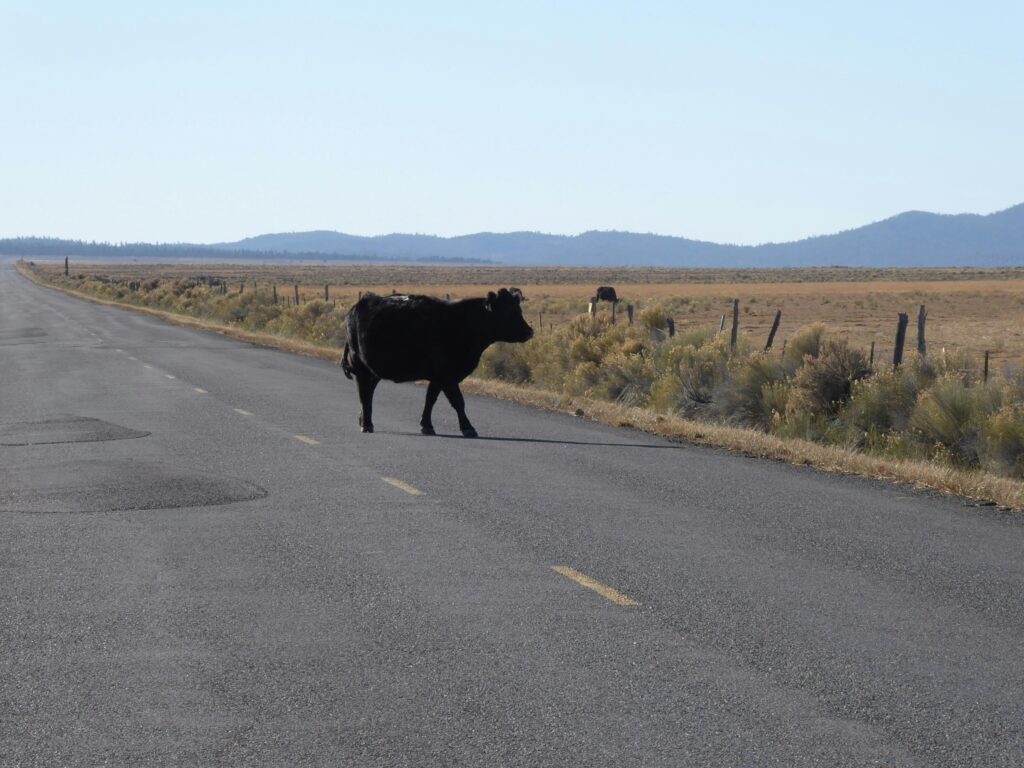
Rowdy Escobar was driving his motorcycle down U.S. Highway 84 in Coleman County. About 1:30 am, he was killed when his motorcycle struck a black cow owned by Charlotte Mullins on the highway.
At the time of the accident, Charlotte leased land west of Highway 84 and had 47 cows on the property. Under the terms of the lease, Charlotte was responsible for maintaining the fences on the land. It was undisputed that the cow Rowdy hit came from this pasture.
Rowdy’s family filed suit against Charlotte.
Evidence at Trial
On the night of the accident Charlotte was at her residence 200 miles away from the leased property. Charlotte had last been at the property a week before the accident. She testified that she believed the fences were suitable for containing cattle. Charlotte never had a cow out since she took over the cattle operation in 2017, but there were three instances of cattle getting out while she and her husband were managing cattle together prior to 2017 and one instance some 20 years ago when her mother-in-law managed the land.
The night of the collision, she received a call from her sister-in-law that there was a fire in the area. Charlotte said she was concerned that fires can spook cattle and she was worried about the cattle getting out of the pasture. Charlotte did not come to the property that night given the length of the drive and the fact that her sister-in-law drove down the highway and told her that she did not see any cattle out. Charlotte testified she did not know how the cow got out or what caused it to do so.
Chris Guerrero was bailing hay on Charlotte’s property at the time of the accident. He could hear the motorcycle and see its headlight. He testified that the collision happened at the top of the hill, and that he did not believe Rowdy had time to see the cow.
Rowdy’s family hired a fencing expert, Bob Kingsbery, who testified that Charlotte should have known fires can be harmful for cattle and fences and should have come to the property that night to inspect the fences. He testified that he inspected the fence 10 months after the accident and found brush and trees growing in the fence line and noted there were places where the height of the fence was less than the industry-standard 48 inches. He testified that a person cannot inspect and maintain a fence if they cannot see it and that brush growing in the fence can loosen the wires. He testified the barbed wire was old and less sharp and that the wires were loose. He testified that it was “inevitable” for cattle to get out on the highway because the fence was not sufficient to hold cattle. On cross examination, he admitted that he did not know how the cow escaped from the pasture, admitted that sometimes cattle get out due to no fault of the owner, and said that while he was there only to testify about fences, there was no evidence that Charlotte “knowingly permitted” the cow to run at large. On redirect, he testified it was “probable based on the circumstantial evidence” that the cow just climbed over the fence or stepped over it.
In closing arguments, Rowdy’s family’s attorney described Charlotte as “an absentee rancher who turned a blind eye, her cow escapes, and we lose [Rowdy Escobar.]”
Verdict
The jury found that Charlotte did “knowingly permit” the cow to run at large and awarded the Escobar family $260,000. Charlotte appealed.
Court of Appeals Opinion
The Eastland Court of Appeals reversed. [Read Opinion here.] The court walked through the case law involving livestock on Texas highways.
Case Law Review
While there is no common law duty for Texas livestock owners to fence their animals in, there are two statutory duties to restrain livestock that apply in certain areas. At issue here is the duty imposed by Texas Agriculture Code Section 143.102. Two recent cases have applied this standard.
Pruski v. Garcia
A bull escaped his pasture and was hit on a state highway in Wilson County. The Texas Supreme Court held that when a collision occurs on a State Highway, an animal owner can be found liable only if his or her “knowing” mental state can be proven. The Texas Agriculture Code Section 143.102 provides that “a person who owns or has responsibility for the control of certain livestock including cows may not knowingly permit the animal to traverse or roam at large, unattended on the right-of-way of a highway.” The term “highway” in this section is defined as any State or US highway. The Supreme Court noted that “permit” usually “connotes awareness or assent, as opposed to mere oversight or negligence.” The requirement not to allow animals to roam or run at large historically meant more than temporary escape, referring instead to allowing animals to graze and move about freely in an unconfined area. [For more information on this opinion, click here.]
Arraby Properties, LLC v. Brown
Arraby Properties is the only case thus far to have applied the Texas Supreme Court’s Pruski decision. In Arraby Properties, a motorist struck a cow on a state highway one morning. Two days before the accident, the cow was reported missing from property occupied by an elderly couple. The trial court found in favor of the Plaintiffs, but the appellate court reversed, finding insufficient evidence to support a finding that the owners knowingly permitted the cow to run at large. Importantly, the court noted “Section 143.102 does not impose a duty to prevent all escapes of fenced animals.” Mere knowledge that a cow may escape from a pasture is not sufficient to establish the “knowingly” element under Texas law. Thus, the fact that an animal owner “should have known–but does not actually know” does not constitute knowingly. Given the lack of evidence of the fence being in disrepair and the fact that no cattle had been out before, the court held that the cattle owners did not knowingly permit them to run at large. [To read more about this opinion, click here.]
Interestingly, Mr. Kingsbery, the fence law expert who testified in the Mullins case also testified for the Plaintiffs in Arraby Properties. In that case, there was no evidence regarding fence maintenance or quality because neither Kingsbery nor the police officers ever inspected the fence.
Law Applied to Case
Charlotte challenged the jury’s finding that she “knowingly permitted” the cow to run at large, claiming there was no evidence to support this finding. She noted that there was no evidence regarding how long the escaped cow had been out, how it escaped, or that she was aware of the cow’s presence on the highway at the time of the collision.
First, the court noted that Texas law makes no distinction as to the duty owed by an absentee livestock owner and that owned by a resident livestock owner.
Second, the fact that there was a fire in the area the night of the accident did not modify the duty owed by a livestock owner. There is no duty for a livestock owner to patrol land along the right of way to make sure livestock remain contained. “That duty does not exist[.]” Were a cow to escape due to being spooked by a fire, that would constitute a temporary escape for which liability would not be imposed under Section 143.102.
Third, the court considered the evidence related to Charlotte’s knowledge. The Plaintiffs relied upon Mr. Kingsbery’s inspection of the fence and testimony that it was inadequate to support the jury’s verdict. The court found that the evidence presented did not support a finding of reasonable certainty on the part of Charlotte. The most probative indication of knowledge would be awareness that the particular animal involved in the collision had escaped. Charlotte had no such knowledge here. The fact that there had been other temporary escapes several years (and even two decades) before was not sufficient evidence to support a finding of culpability. Further, the escapes that occurred from 2008-2016 involved a car driving through a fence and someone leaving a gate open. Importantly, neither involved cattle getting out due to insufficient fences. There was one unexplained escape three years before this accident, but the court found that due to the time and the unknown cause of that escape, it was not sufficient evidence to prove a knowing mental state in this case.
Conclusion
Because there was no evidence that Charlotte knowingly permitted her cattle to run at large on Highway 84 and no evidence in the form of recent escapes due to inadequate fences to show she was reasonably certain her cattle would escape, the court reversed the judgment of the trial court and entered judgment in favor of Charlotte Mullins.
Key Takeaways
This case is an important reminder of the “knowingly permit” standard applicable to animal owners when collisions occur on State or US Highways. There is language in this opinion that would be useful to an animal owner in future cases, particularly that of a “temporary escape” not being sufficient to prove the knowing mindset.
Additionally, it is always important for livestock owners to carry liability insurance in case a situation like this arises and they find themselves faced with a lawsuit.
For more information on Texas Fence law, check out our Five Strands Handbook and this podcast episode with Kyle Weldon.