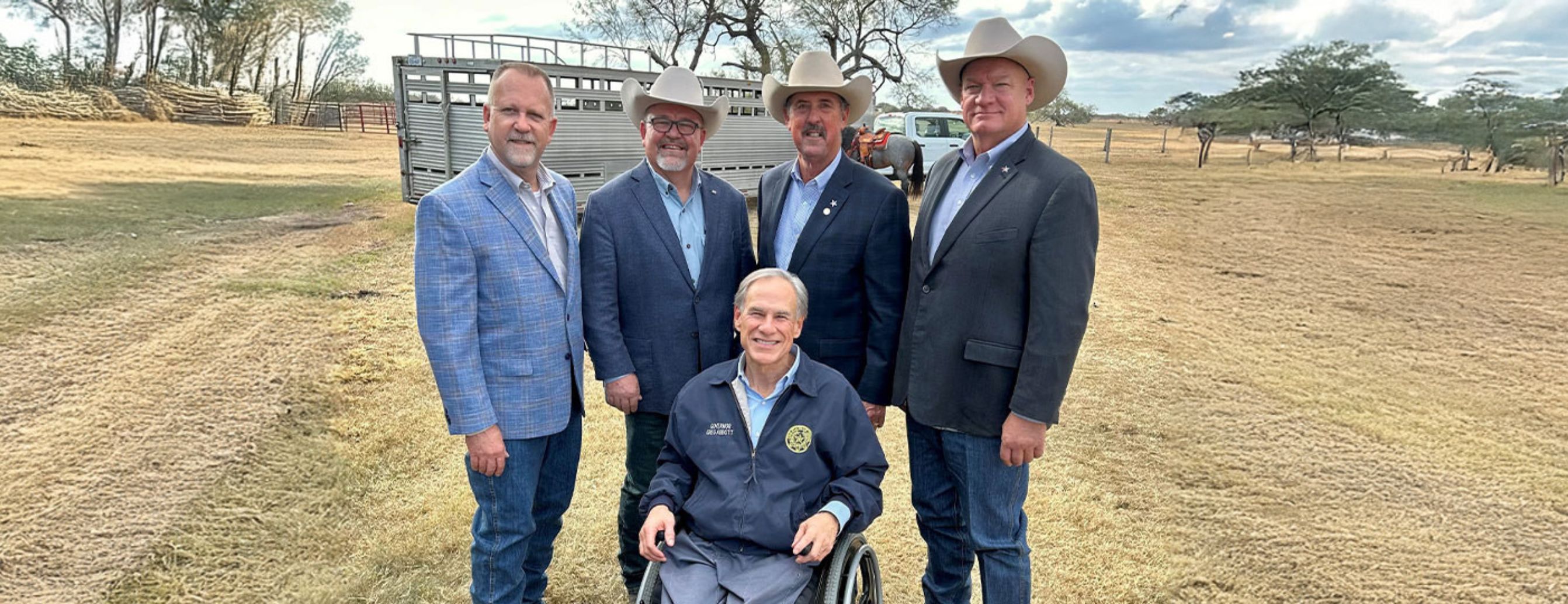
Abbott Issues Disaster Declaration Over Screwworm Threat
Gov. Greg Abbott issued a disaster declaration Thursday as New World screwworm infestations in Mexico move closer to the Texas border, posing a significant threat to Texas agriculture and wildlife.
The declaration allows state agencies to mobilize additional resources and take preemptive action to prevent the pest from spreading into Texas.
“State law authorizes me to act to prevent a threat of infestation that could cause severe damage to Texas property, and I will not wait for such harm to reach our livestock and wildlife,” Abbott said. “With this statewide disaster declaration, the Texas NWS Response Team can fully utilize all state government prevention and response resources to prevent the re-emergence of this destructive parasite. Texas is prepared to fully eradicate this pest if need be.”
As part of the declaration, Abbott directed the Texas Parks and Wildlife Department and the Texas Animal Health Commission to establish a joint Texas New World Screwworm Response Team. Texas Farm Bureau is a member of this task force.
“Texas Farm Bureau applauds Gov. Greg Abbott for taking proactive action to prevent the New World screwworm fly from threatening Texas livestock and wildlife. This preemptive disaster declaration gives Texas greater flexibility and resources to respond quickly and effectively should the pest reach our state,” Texas Farm Bureau President Russell Boening said. “Activating the Texas Department of Emergency Management ensures coordination and readiness across agencies to address this serious threat.
Screwworm larvae burrow into the skin of living animals, causing serious and often fatal damage.
One female fly can lay 200-300 eggs at a time and may lay up to 3,000 eggs during her lifespan, according to the U.S. Department of Agriculture (USDA).
To eradicate the pest, sterile male flies are bred to mate with fertile female flies, which only mate once in their lifetime. This process leads to a population decrease until it eventually dies out. This method successfully eradicated the pest from the U.S. in 1966 and later in 2016 when the screwworm was confirmed in Florida.
USDA has committed $750 million to build a sterile-fly production facility in the Rio Grande Valley, which is expected to release up to 300 million sterile flies per week.
A distribution facility is expected to open in the Valley early this year, and USDA also dedicated an additional $100 million to research and development of new tools and technologies that will aid in the response.
“Preparedness remains our strongest defense against this destructive pest,” Boening said.
The fly is endemic in parts of the Caribbean and South America.
For more information about NWS, visit screwwormtx.org and screwworm.gov.